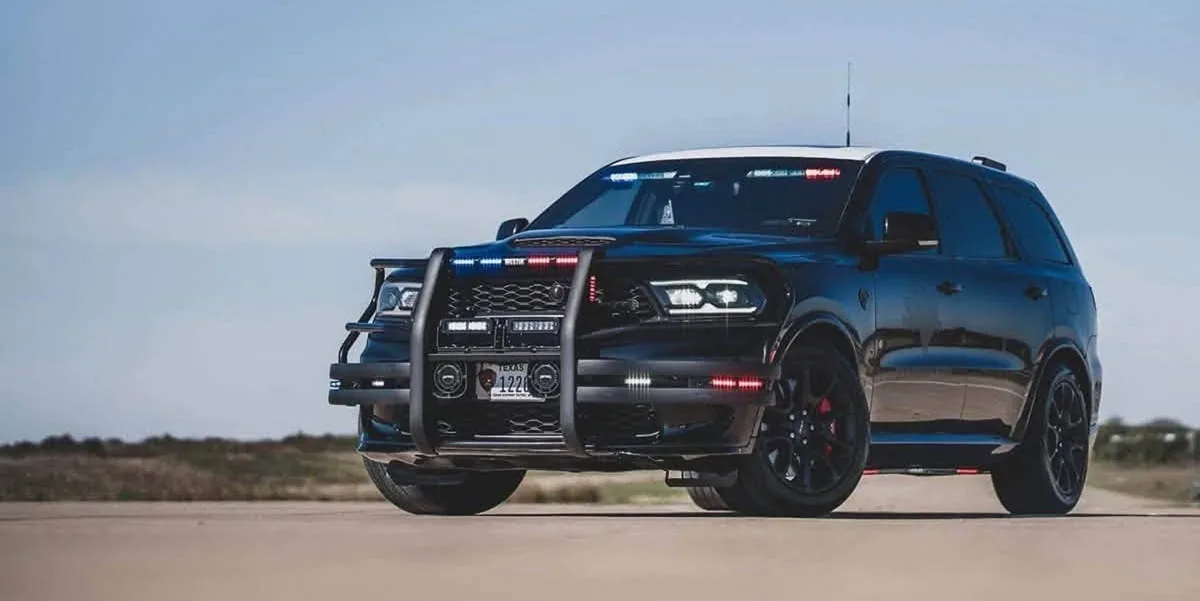
Texas Public Safety Officials Add a 710 Horsepower Dodge Durango SRT Hellcat to Their North Texas Fleet for Patrol and Community Use
AUSTIN, TX — The Texas Department of Public Safety’s North Texas Region has added a Dodge Durango SRT Hellcat to its fleet, bringing a 710-horsepower SUV into service for public safety work. The agency announced the addition on Facebook and paired the news with a simple message: “All that horsepower. One mission: Public Safety.”
The move puts one of the most powerful versions of the Durango into a law enforcement role in a state known for big distances and long highways. DPS did not spell out exactly how the vehicle will be used, but the announcement made clear that the SUV is now part of the department’s North Texas operation.
A supercharged V eight with 180 mile per hour capability
Under the hood, the Durango SRT Hellcat uses a supercharged 6.2-liter V-8, the same basic formula that has made Hellcat models known for brute-force acceleration. Dodge rates the SUV with a top speed of 180 miles per hour, giving it the kind of straight-line performance that would stand out in almost any police fleet.
The department did not discuss pursuit tactics or specific response scenarios, but the vehicle’s performance figures suggest it could be used where rapid travel across large stretches of roadway matters. In a state as spread out as Texas, the appeal of a fast response vehicle is obvious, even if the Hellcat’s output is far beyond what most patrol vehicles can deliver.
Weight and size may matter as much as speed
Speed is only part of the story. The Durango SRT Hellcat weighs roughly 5,600 pounds, which could make it a useful tool if the department needs a substantial SUV for heavy-duty driving situations. That mass may offer some practical reassurance in the kind of work police vehicles can face on Texas roads.
At the same time, the vehicle’s size and strength raise practical questions about whether a high-performance SUV like this is meant for everyday patrol, emergency response, or a more limited role. Texas DPS has not provided those details, leaving open questions about how often the Hellcat will actually be pushed to its limits.
Fuel economy could limit how often it is pushed hard
The Hellcat’s biggest tradeoff may be fuel use. The Environmental Protection Agency rates the Durango SRT Hellcat at 14 miles per gallon combined, and that figure would likely drop further during hard driving or emergency use. For a vehicle built around a supercharged V-8, efficiency is clearly not the selling point.
That matters for a public agency that may need to balance performance with operating costs and range. Even a powerful SUV can be less useful if it burns through fuel quickly, especially if it spends time in pursuit mode or covering long distances across North Texas.
The SUV could serve patrol duty or public events
It remains unclear whether the Durango SRT Hellcat will mainly chase violators on highways or appear more often at community events and public outreach appearances. Those are both possibilities, and the department has not said which role will be primary.
Either way, the SUV is likely to draw attention wherever it goes. A 710-horsepower police vehicle is unusual enough to stand out in any setting, and in Texas it fits a broader image of doing things at a larger scale than most other places.
Why the addition fits Texas but still raises questions
Texas is known for big spaces, long drives, and a culture that often embraces oversized machinery, so the idea of a Hellcat police SUV may not seem as far-fetched there as it would elsewhere. The vehicle matches the state’s reputation for doing things bigger, faster, and louder.
Still, the addition leaves questions about cost, deployment, and practicality. The SUV is expensive, powerful, and thirsty, yet the department has said only that it will serve public safety. For now, Texas DPS has added one of the most extreme performance SUVs on the market to its fleet and left the public to wait for more specifics.