Smoke From Los Angeles Fires Exposed Millions to Toxic Heavy Metals as Researchers Found Lead Levels Far Above Normal During the 2025 Blaze
LOS ANGELES, CA — A new study says smoke from the 2025 Los Angeles fires exposed millions of people to dangerous levels of toxic heavy metals, with lead concentrations reaching 80 times the usual background level over a 24-hour period.
Researchers found that the smoke plume from the Eaton Fire contained far more lead, arsenic and halogens than smoke from a vegetation fire, underscoring how fires that burn through neighborhoods can create a very different health threat than wildland blazes alone.
The findings, published Wednesday in Science Advances, come as scientists warn that larger and faster-moving fires are increasingly pushing into urban areas. That shift, they say, changes what burns, what enters the air and what residents breathe.
Urban smoke carried far more lead than wildfire smoke
Researchers from the California Institute of Technology compared smoke from the Eaton Fire with smoke from a 2024 fire in Riverside County that burned mostly vegetation. The difference, they found, was striking.
The Los Angeles plume contained 50 times more lead, three times more arsenic and seven times more halogens than the wildfire smoke. Those halogens include chlorine and bromine, elements linked to burning vehicles, building materials and electronics.
Nga Lee “Sally” Ng, one of the study’s authors, said the work shows that wildfire smoke and urban fire smoke are fundamentally different. With newer measurement tools, she said researchers could see the detailed makeup of the particles people were breathing during the blaze.
The Eaton Fire plume reached millions across Los Angeles
At the peak of the fires, about 7 million people were exposed for 24 hours to lead levels more than 80 times higher than normal, according to the study’s estimates. The researchers used hourly measurements from the Atmospheric Science and Chemistry mEasurement NeTwork, or ASCENT, to track how the smoke changed over time.
ASCENT is a relatively new national network of air quality monitors that measures the size and chemical composition of fine particulate matter in real time. Ng said it is the first U.S. network able to do that kind of chemical monitoring as smoke moves through a region.
That hourly data let the team follow emissions as the fire developed and separate smoke from burning structures from other fire-related pollution.
Homes, cars and electronics added to the toxic load
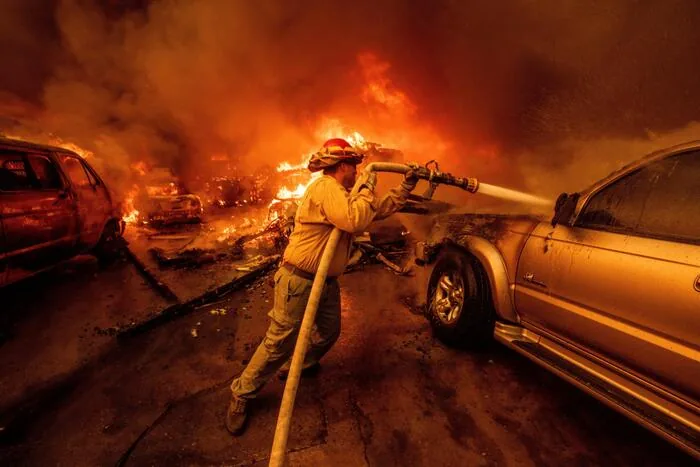
The fires that hit Altadena and the Pacific Palisades on Jan. 7, 2025, killed at least 31 people and destroyed more than 16,000 structures, mostly homes. Those buildings contained cars, paint, furniture, chemicals stored under sinks and other materials that can release hazardous pollutants when they burn.
Researchers say that mix helps explain why urban fire smoke can become so dangerous. When flames consume houses and businesses, they can also burn lead from wall paint, plastics and electronics, adding toxic metals and other compounds to the smoke plume.
Scientists have also been learning more about what can remain after major fires. A recent study on the 2023 Maui wildfires found that metal mixtures in leftover smoke, ash and debris harmed the lung health of people living nearby long after the flames were out.
Lead and arsenic raise health concerns after short-term exposure
Lead is a neurotoxin that can hinder children’s development, lower IQ scores and raise blood pressure in adults. Scientists still do not know exactly how brief but intense exposure affects human health, which makes the Los Angeles findings especially concerning.
Arsenic exposure is associated with several cancers, adding another layer of risk to smoke that already carries fine particulate matter. The study focused on PM2.5, the tiny particles that can move deep into the lungs and enter the bloodstream.
Ed Avol, professor emeritus at the Keck School of Medicine at the University of Southern California, said the heavy-metal exposure was consistent with what he would expect, though still surprising because it had not been documented this clearly before.
Scientists say monitoring and emergency planning must change
Experts quoted in the study say the findings have clear public-health implications. Yaguang Wei, an assistant professor at the Icahn School of Medicine at Mount Sinai, said governments should strengthen wildfire monitoring, improve public alerts and expand prescribed fires to reduce risk.
Wei said the research supports the idea that smoke from burning buildings may be more toxic than smoke from other sources. He said that when properties burn, they release metals and chemicals built into modern homes and electronics.
Avol said the results highlight a “strange and increasingly dangerous new world” where urban neighborhoods and wildfire zones overlap. He said the challenge now is figuring out how to protect people from exposure in places where so many metal-containing materials are part of everyday life.
A warmer, drier climate is helping fires spread into cities
The study also points to a larger trend. Wildfires are becoming larger, more intense, faster-moving and more frequent, researchers said, in part because warmer and drier conditions linked to human-caused climate change are making fires easier to start and harder to stop.
As urban growth continues and more fires move into populated areas, scientists say emergency response systems will need to adapt. That includes better real-time monitoring of smoke chemistry, faster warnings for residents and planning that accounts for what burns in modern cities.
For Los Angeles residents, the study adds new detail to the scale of the 2025 disaster. It shows that the danger was not only from flames and ash, but also from a toxic smoke cloud that spread across the region while the fires were still burning.