Florida Helicopter Flew Extremely Close to the Water Before Fatal Crash Near Key Biscayne, Investigators Say in Preliminary Findings
MIAMI, FL — A helicopter flying near Key Biscayne came down after operating so low over the water that its main rotor blades struck the surface, according to preliminary findings released by the National Transportation Safety Board. The aircraft crashed Nov. 4 near Bill Baggs State Park during a flight intended to capture footage of an offshore powerboating event.
The crash killed the pilot and injured a photographer and a videographer who were on board, the Miami-Dade Sheriff’s Office said. Investigators said the helicopter had been making low-altitude turns close to the water before the impact. The safety board described the aircraft as being “extremely” close to the surface when it struck the water.
Investigators say the helicopter was maneuvering low for filming
The National Transportation Safety Board said the Robinson R44 II was being used for aerial photography and videography when the crash happened. To make that work, several doors had been removed from the helicopter before the flight.
According to the preliminary findings, the aircraft made a turn so close to the water that the main rotor blades clipped the surface. That impact brought the helicopter down into the water. The safety board’s account indicates the flight path was shaped by the need to get close shots of a boat during the event.
One of the people on board told investigators the helicopter had been flying low and parallel to the right side of a boat before turning ahead to get a better angle as the vessel passed underneath. The videographer then saw the rotor blades hit the water, the findings said.
Pilot killed, two passengers injured in the Nov. 4 crash
Authorities said the pilot died in the crash. The photographer and videographer survived but were hurt. Officials have not publicly detailed the extent of their injuries in the information released with the preliminary findings.
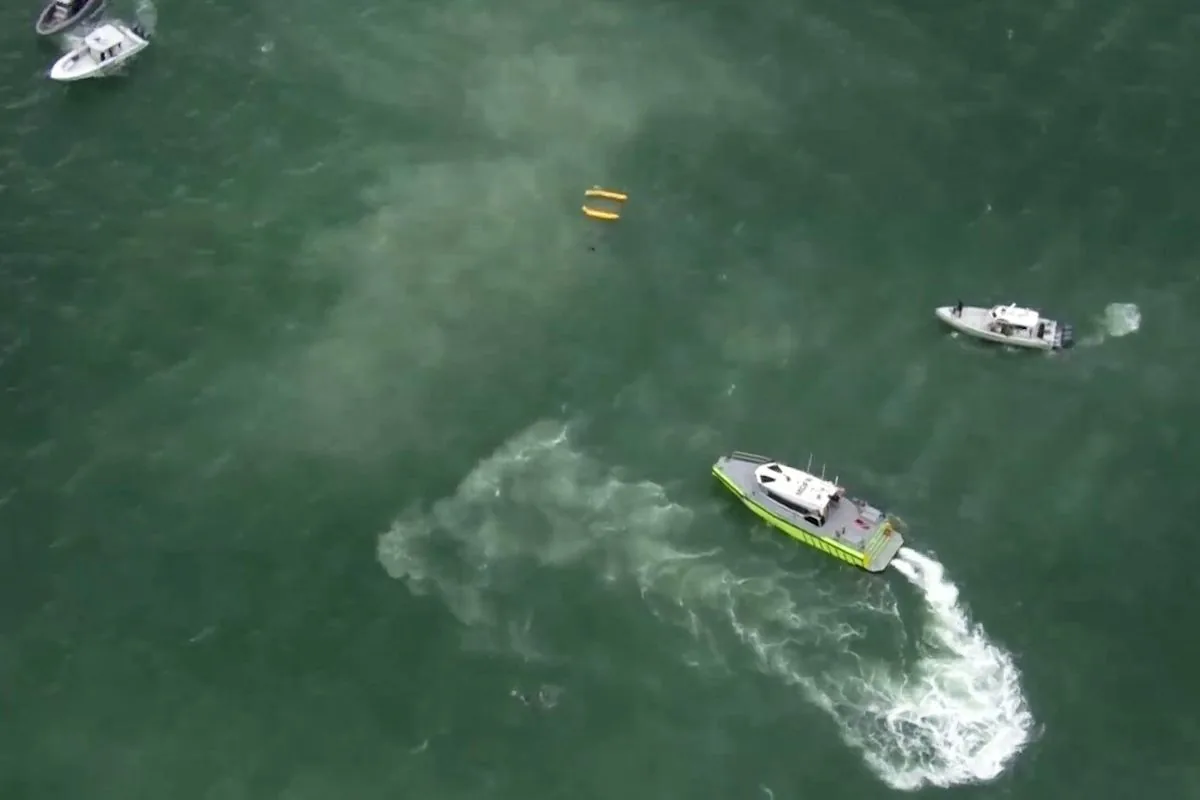
The helicopter ended up upside down underwater, television news footage showed. Two yellow floats were visible on the bottom of the landing skids, showing the aircraft was equipped with emergency flotation devices meant to help keep a helicopter afloat after a water landing.
The wreckage scene suggested the aircraft came to rest in the water quickly after impact. The safety board’s early findings do not provide a final cause, but they do point to the low-altitude maneuvering as the critical sequence leading to the crash.
Witnesses on boats called for help as crews rushed in
People aboard nearby boats spotted the emergency and called for help, Miami-Dade Sheriff Rosie Cordero-Stutz said. A good Samaritan also tried to help one of the victims, she said.
Multiple agencies responded to the crash site. Rescue personnel from local departments were joined by the U.S. Coast Guard and U.S. Customs and Border Protection. The water rescue effort unfolded near a busy recreational area off Key Biscayne, where boat traffic was present during the incident.
Officials have not said whether the flight was part of a commercial assignment or what specific safety measures were in place beyond the removed doors and flotation gear. The preliminary findings focus on the aircraft’s path and the moment the rotor blades hit the water.
Bill Baggs State Park sits near a busy stretch of South Florida shoreline
The crash happened offshore from Bill Baggs State Park, a waterfront area at the southern tip of Key Biscayne that draws boaters and visitors along a heavily used stretch of South Florida coastline. The location is known for open water views and frequent recreational activity.
That setting mattered because the helicopter was filming an offshore powerboating event when it went down. The aircraft’s mission required it to stay near the action, but the preliminary findings suggest the maneuvering left little margin between the rotor blades and the water’s surface.
The NTSB’s initial account does not say whether weather, visibility, or mechanical problems played any role. For now, investigators are describing a sequence in which low turns, close proximity to the water, and rotor contact led directly to the crash.
What the preliminary findings mean as the investigation continues
Preliminary findings are an early step in a federal crash investigation and can change as more evidence is reviewed. In this case, the NTSB’s account lays out the flight profile, the water impact, and the emergency response, but it does not deliver a final determination.
Investigators will typically continue to examine the wreckage, flight conditions, maintenance records, and witness accounts before issuing a final report. The Miami-Dade Sheriff’s Office and other responding agencies have already identified the crash as fatal for the pilot and injurious for the two other people on board.
For now, the key conclusion from the safety board is straightforward: the helicopter was operating extremely close to the water when its rotor blades struck the surface and the aircraft went down.