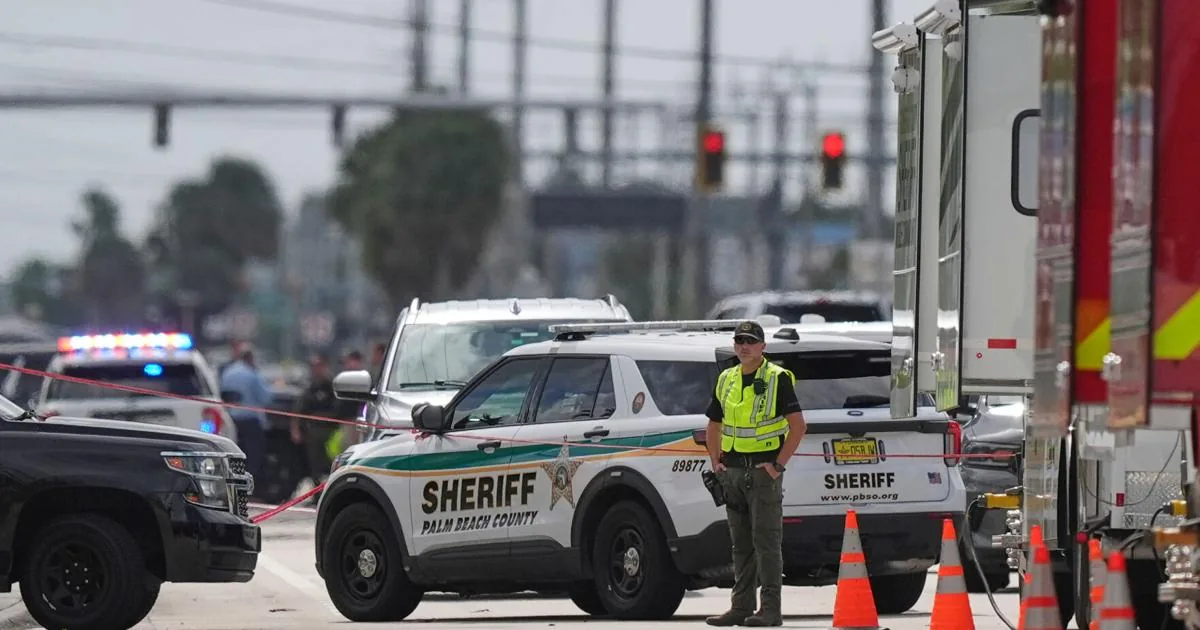
Investigators Say Learjet That Killed Nine in Florida Broke Apart Before Impact as Crews Recover Wreckage and Study Weather Factors
GREENACRES, FL — Investigators say a Learjet that crashed in Florida and killed all nine people aboard was breaking apart before it hit the ground. National Transportation Safety Board member Tom Chapman said Tuesday that a major portion of the left elevator, a tail component that helps control pitch, was found in three pieces as far as 3.8 miles from the crash site.
The discovery adds another layer to the investigation into the Sunday afternoon crash near West Palm Beach. Chapman said the finding is important, but it does not yet explain what caused the aircraft to lose control or whether the part separated because of forces involved in the dive.
He said the agency is still working to determine what happened in the final moments before impact.
Debris found miles away points to an in-flight breakup
Chapman said most of the left elevator was recovered between about 1.3 miles and 3.8 miles from Greenacres, where the jet went down. That debris field is helping investigators reconstruct how the aircraft moved before impact and whether structural failure, flight dynamics, or some other factor set off the chain of events.
An aviation safety expert, Jeff Guzzetti, told The Associated Press that the debris pattern suggests the elevator pieces probably came off close to the ground rather than at high altitude. He said that if the parts had separated much earlier, they likely would have landed much farther from the crash site.
Chapman also said the aircraft would have been difficult to recover from a nosedive without that elevator intact, though he cautioned that the speed and conditions may have made recovery impossible even if the part had remained attached.
Weather and ice are central questions in the crash probe
Weather remains a major focus for investigators. Chapman said Tuesday that the team is continuing to examine how conditions may have affected the flight, including reports of turbulence and ice. The aircraft’s final radio transmissions and other evidence are being reviewed alongside witness accounts and video.
The plane hit the ground with enough force to leave a crater and burst into flames. Investigators have been gathering dashcam footage and interviewing witnesses while also dealing with heavy rain that has slowed access to the site.
Crews expect to reach the crater on Wednesday and believe more critical pieces of the aircraft may still be there. Those parts could help show whether the jet was already damaged before impact or whether the breakup happened during the descent.
Final radio calls described a rapid descent and worsening conditions
In the last two minutes before the crash, co-pilot Nathalia Gadelha Filgueiras shifted from routine communication with air traffic control to urgent warnings as the aircraft plunged. She reported that ice was accumulating on the plane and said turbulence had thrown it up and down by more than 700 feet.
Her final warning was stark: “We’re going to crash into the ground,” followed by, “We’re out of time!” The jet was descending at more than 20,000 feet per minute when the transmissions ended, according to the account described by investigators and family members.
Before that final stretch, Filgueiras had also texted her boyfriend about ten minutes before the crash, saying, “I’ve got turbulence, I’ve got ice,” according to her stepfather.
Victims included a family traveling to the Bahamas and two crew members
The Bahamas-bound Learjet 60 had taken off from Austin, Texas, and the victims included technology entrepreneur Adam Robinson, his wife, Helen Sharp, and their two young children, according to relatives. Jeff Gregory, 55, who lived in the Philadelphia suburbs, was also among the dead.
Gregory was one of two crew members in the cockpit. Friends and colleagues described him as a longtime aviator, husband, father and devout Christian. As the plane was falling, a man’s voice could be heard reciting the Lord’s Prayer in the background of the co-pilot’s final radio transmissions.
Those close to Gregory believe the voice was his. The recordings have added a personal and emotional layer to a tragedy already under close scrutiny by federal investigators.
Friends raise money for pilot Jeff Gregory as families mourn
Thomas Noetzel, director of operations at Upper Jets, the company that operated the flight, organized an online fundraiser to support Gregory’s wife and children. On the campaign page, he called Gregory a close friend and said knowing him made him a better person.
Noetzel’s father, Walter, also posted a tribute on Facebook, describing Gregory as “devoted, conscientious, and deeply faithful” and saying he had a real passion for flying and a strong love for the Lord. Those tributes have circulated among friends and family as the investigation continues.
The crash has also displaced about 600 nearby residents, though only one person on the ground was reported injured. The aftermath has left both the neighborhood and the victims’ families waiting for answers.
What investigators expect next as the NTSB timeline advances
The National Transportation Safety Board plans to release a preliminary report in about a month, but officials say it could take more than a year before the probable cause is determined. Chapman said the agency still needs to recover additional components and piece together the aircraft’s final moments.
Investigators are also expected to keep analyzing the debris pattern, weather data and cockpit communications. Together, those pieces may show whether the fatal dive began with a mechanical problem, weather-related forces, or a combination of factors.
For now, the confirmed facts are limited but significant: the aircraft broke apart before impact, weather is under review, and the crash killed everyone on board. The next steps will determine whether the left elevator failure was the result of the dive or part of what started it.